
Why FSXIO Exists
Industrial applications often require common capabilities that developers rebuild repeatedly: tag-based data management, real-time data flow, time synchronization in closed networks, multi-threaded processing, logging, and a foundation for building web-based industrial interfaces.
FSXIO provides these capabilities as a cohesive, engineer-focused runtime. It lets developers focus on business logic—business rules, calculations, orchestration, analytics—while FSXIO handles the heavy lifting of real-time data management, timing, and deployment flexibility.
It is designed for teams who need to build industrial systems that are fast, reliable, time-aware, and deployable anywhere: edge devices, VMs, cloud infrastructure, or embedded-like environments.
How It Works
FSXIO operates as a central runtime engine that manages industrial data and application logic in real time.
Conceptual Architecture
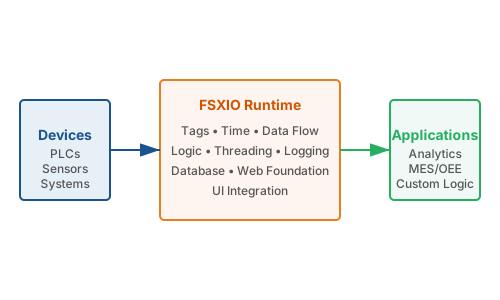
FSXIO sits between industrial data sources and the applications that consume or act on that data.
Key Capabilities
- Real-time data orchestration: Ingests data from devices and systems, normalizes it, and distributes it to applications in real time.
- Time awareness: Maintains accurate timing even in closed networks without internet or NTP access—critical for industrial precision.
- Multi-threaded processing: Handles concurrent operations safely, so business logic can run in parallel without complexity.
- Persistent logging: Records data and events with industrial-grade reliability.
- Database integration: Interfaces with standard databases for storage and queries.
- Web interface foundation: Provides the plumbing for web-based industrial UIs without requiring separate state management.
Standards-Aligned by Design
- Industrial model alignment: Language and addressing are aligned with ISA‑95 concepts — plant / line / equipment hierarchy is the primary model, and analytics and alerts are scoped to equipment context.
- Alarms as first-class objects: Alarm handling is designed around ISA‑18.2 / IEC 62682 principles; alarms have explicit lifecycle states (active, acknowledged, cleared).
- Time-qualified, persistence-based activation: Alarm conditions use time qualification and persistence rules to avoid transient alerts.
- Invalid-data suppression: Alarms and analytics are suppressed when inputs are evaluated as invalid, unreliable, or stale; such data never drives alarms or calculations.
- Explicit data-quality semantics: Data validity is explicitly evaluated and classified (usable vs non-usable), with timestamp-based freshness governing usability and handling aligned with IEC 62541 concepts.
- Engineering-focused auditability: Events, state transitions, and data-quality decisions are recorded to support engineering review and operational audits.
Tag-Centric Philosophy
FSXIO is organized around tags—the fundamental units of industrial data. A tag is a named, time-stamped value that represents a piece of real-world state or computed data.
Three Types of Tags
Hardware Tags
Connected directly to devices—PLC registers, sensor values, network inputs. FSXIO reads and writes these in real time.
Virtual Tags
Memory-resident values managed by FSXIO or application logic. Used for intermediate calculations and state.
Computed Tags
Derived from other tags through formulas, aggregations, or custom logic. Always up-to-date as inputs change.
Why Tags Matter
Tags eliminate redundant state management. Instead of storing data in multiple places (devices, databases, UI), a single tag becomes the source of truth. Applications read from and write to tags; FSXIO synchronizes them everywhere they're needed.
This makes industrial applications simpler to reason about, faster to debug, and easier to scale.
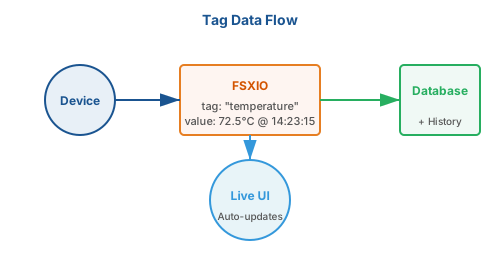
A tag is created once, read by all applications, and synchronized automatically across storage and UI.
Frontend Integration Capability
FSXIO includes a lightweight concept for binding industrial UI elements directly to real-time tags.
What This Means
UI components—gauges, graphs, digital readouts, SVG-based schematics—can be connected to tags. When a tag value changes, the UI updates automatically. Developers write business logic once; the UI stays in sync without duplicating state or writing observers.
- No state duplication: Tag is the single source of truth.
- Live visualization: Industrial dashboards respond immediately to real-world changes.
- Lightweight: No heavy client-side frameworks required for simple interfaces.
- Industrial-appropriate: Built for real-time data, not general web applications.
Clear distinction: This is a backend-to-frontend integration capability. FSXIO is not a UI framework, and this is not a drag-and-drop editor. It is a technical foundation that lets front-end code (HTML, SVG, or custom scripts) bind to real-time tag data.
What FSXIO Enables
FSXIO is well-suited as the foundation for building:
What you build is up to you. FSXIO provides the industrial data foundation; application logic and features are your domain.
What FSXIO Is Not
Clarity on scope prevents misalignment. FSXIO is not:
A ready-made SCADA product
FSXIO does not include pre-built operator screens, alarm management, or historical trending. It is a runtime foundation for building such systems. You provide the application layer; FSXIO provides the data backbone.
A low-code or no-code platform
FSXIO requires development. Configuration alone is not sufficient. You need engineers who can write application logic, integrate protocols, and deploy systems.
A generic web framework
FSXIO is not React, Vue, Angular, or a general-purpose application server. It is a specialized runtime for industrial data and real-time systems.
A cloud-only service
FSXIO can run in cloud environments, but it is not cloud-dependent. It is built for edge, on-premises, VMs, and diverse deployment scenarios. It works in air-gapped networks.
A magic solution
FSXIO handles industrial data foundation well. You still need to architect your application, choose your deployment model, manage your database, and test your system.
Licensing
FSXIO is licensed as part of deployed industrial systems.
Licensing Model
Licensing is typically based on deployment context: runtime-based (number of FSXIO instances) or deployment-based (target environment). The structure depends on project scope, system architecture, and integration requirements.
Pricing and structure are not one-size-fits-all. They are determined during project planning and scoped to your specific needs. There is no self-service or public pricing; licensing is discussed as part of understanding requirements.
If you are evaluating FSXIO for a specific application or system integration, the right people to talk to are those who understand your architecture and timeline.
Accountability & Engineering Origin
FSXIO is developed and maintained by an engineering team with deep experience in long-term industrial deployments, integration, and real-time systems.
The design reflects years of learning what industrial applications need: time reliability, data synchronization, deployment flexibility, and a foundation that doesn't get in the way.
FSXIO stands on its own as a product. It is built to last and to work in real industrial environments—not as a quick prototype or proof-of-concept tool.